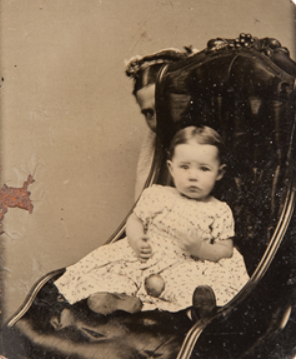
These are referred to now as “hidden mother” photographs. The practice was so widespread that there are thousands of still-surviving photos of babies being calmed and kept still by strangely obscured women. To a modern viewer the resulting images, achieved through various methods of concealment, range from comedic to macabre.
We have the more obvious “just out of sight/cropped out” method:
The often extremely creepy “covered by a blanket or curtain” method:
And the drastic “painting over or scratching off the mother’s face” method:
“Why did they go through all this effort, especially when so few images were actually successful at hiding the mother?” you may ask. The truth is, we don’t know. And contrary to what conclusion you might immediately jump to, there’s no indication in the research that this was driven by misogyny or a devaluation of motherhood. There are just as many examples of normal family photos and mothers openly seated with their children. It simply seems to be the desire for solo images of babies (after all, don’t your parents have studio portraits of you as a toddler or infant lying around?), and no better way to go about it while the exposure times were so long. Plus, putting the photos in elaborate frames was the common practice, adding extra cover.
And no, it doesn’t have anything to do with Victorian spirit photography either. They weren’t trying to look like upholstered ghosts
(although in fairness I believe there is some overlap with post-mortem portraits).
Keep in mind that the populace in this era was also much less visually literate than we are today in the digital age. Photography was extremely new and nothing like it had ever been seen before. It was probably easier for them to suspend disbelief, and pay no attention to the woman behind the curtain.
Bonus: they totally did this with cats too.
I’m guessing, albeit wildly, that the mother would be in motion calming the kids with faces and sounds, and they didn’t want blurry mouth photos so they had them hide, or painted over them later to uh. Much creepier effect.
It doesn’t seem to be an issue with the mother speaking, as there are plenty of normal portraits where the mother holding the child isn’t obscured and neither of them are blurry (or no more blurry than your average unfortunately timed photo of the era, but this didn’t really ruin the portrait anyway). Seems like it was definitely more about wanting those solo baby pictures but having to deal with children moving, otherwise the mother could just stand behind the photographer and make noises/faces the way we do now. The subject of a photo had to remain extremely still, as an exposure time that lasts a minute or more will pick up all sorts of movement. Even older children and adults sitting for their portraits had to be subjected to stands that helped them pose and neck or head rests/clamps.
It doesn’t really work on babies (though I’ve seen a couple photos with a supported toddler in head clamps!).


 Sandra Soapbox Cosplay