Luke decided (and announced publicly and on social media) that playing the piano
non-stop on the village green would be an appropriate way to “win back” the
girlfriend, known to him as “Rapunzel”, who rejected him after their four-month
affair.
There was, understandably, a fair bit of discussion on this.
Some people (mostly men, it seems) thought it was a romantic gesture. Others
(mostly women) thought it wasn’t. After a fair bit of exposure and some fairly
passionate debate, Luke from Bristol has finally stopped playing, after an
incident at 4 am last night (someone punched him – I wonder why?). Since then,
the debate has continued, with some people (mostly men) saying how ungrateful and
incomprehensible women are to reject The Kind of Romantic Gesture All Women
Want, and some (mostly women) saying; “Serves him right.”
Now I don’t know Luke from Bristol. He may well have
problems of his own, and I don’t believe that punching anyone in the face is necessarily
the best way to solve them. However, there is a conversation to be had about male
perceptions of What Women Want, and women’s perceptions of What Makes a
Romantic Gesture, and how those ideas can cause conflict, misunderstanding,
and, in some cases, abuse.
First, let’s look at where the idea of the Grand Gesture came
from. Given the nickname that Luke gave his ex-girlfriend, let’s start with
Rapunzel.
The story: Rapunzel has been trapped in a tower for the
whole of her life. Along comes the Prince to rescue her. After a number of
adventures (tasks), he manages to do so, and thereby earns his reward – that is,
the girl herself, all-too-often represented in fairytales as the prize the hero
wins, after having fulfilled his tasks. This scenario exists in so many classic
fairytales: Snow White; the Sleeping Beauty; Rapunzel. In all these cases, the
girl has never even met the guy she
ends up marrying. Snow White and Beauty are both unconscious: Rapunzel is at
the top of a tower, and presumably only gets to see the top of his head. Not
the greatest basis for a lasting relationship. But these stories are all based
on the idea that the girl will happily put out out of sheer gratitude. The guy wins
the girl by fulfilling a series of tasks. The girl conveniently falls in love
with the guy because he fulfilled all the tasks. No-one ever asks the girl
whether she really wants the guy.
No-one asks what would have happened if she’d just said: “Thanks, but I never
asked you to do these tasks for me in the first place. Now jog on, there’s a
good chap, and let me get on with my own life.”
And here’s the problem. The history of the romantic novel is
littered with this kind of bullshit thinking. The woman is all-too often a passive
player in the game. And modern men and women are still being fed the myth that
men should make grand gestures in order to deserve them.
But here’s the thing. Love just doesn’t work that way. If
you don’t love someone, then no grand gesture is going to change things. The public
proposal at the football match, the guy who fakes his own death before leaping
out of the ambulance covered in theatre blood, clutching an engagement ring
(yes, that did happen); the guy who
swears he won’t stop playing piano until his beloved comes back to him – none of
those gestures will actually make someone love you. At best, they will be embarrassing;
at worst, they seem manipulative, coercive and downright creepy.
It’s hard to turn someone down in public. You’re afraid that
the person will feel humiliated. You’re afraid that all the onlookers will
judge you for being heartless. You say yes because you’re feeling pressured.
Because you’re being publicly coerced by someone who knows exactly what they’re
doing.
In the same way, when someone threatens self-harm, or even
suicide if you refuse to give them what they want, you feel responsible, even
when you’re clearly not. You may even see it as a sign of their love for you,
rather than a sign of entitlement, mental illness or abuse.
But behaviour like that is
abuse. It may not seem that way, but it is. The language of love has traditionally
been all about the cruelty of the woman who won’t put out and the suffering of
the man who wants her to. But really, all it comes down to is the wheedling of
a naughty little boy going: “Please, Mum, pleeeese, oh pleeease, oh, pleeease,
I’ll cry, I’ll scream, I’ll HOLD MY BREATH UNTIL I DIE AND THEN YOU’LL BE SORRY,”
until his mother, out of sheer exhaustion, rewards him with a sweet or a toy,
thereby feeding him the myth that all women will give in eventually, if
pressured enough to do so.
Coercion has nothing to do with love. Public gestures are
all about ego. They’re not for the recipient; they’re for the public. They’re not
sincere. They’re theatre. In the same way, threats of self-harm (be that threatening
suicide or just playing the piano until you drop) are not about love. They’re
about manipulation, which is a form of abuse. Real love puts the other’s
feelings before one’s own. Real love doesn’t want to control or coerce. Real
love cares about what the other person thinks, and when the other person says: “no”,
then real love backs off and shows respect.
Fairytales may be lots of fun, but they’re not a template
for real life. Neither are love stories in fiction. Heathcliff may say he loves
Cathy, but how does he show it? By marrying and abusing another woman; by
tormenting Cathy to death and taking vengeance on her child.
“He loves me with such passion that it comes out in violence”
has been the cry of abused women throughout the ages, in fiction and outside of
it. And yet it’s bullshit: the truth is that a violent man is violent because
he can’t or won’t control his aggression. Love has nothing to do with it,
whatever he might claim. Love is just an excuse for him to keep on with his bad behaviour. And a man who blames women for his own lack of
self-control is a man who may one day attack or maim or kill a woman because he
doesn’t feel accountable for his actions. He’ll say: “She drove me to it.” What
that really means is: “She didn’t give me what I wanted, which in my world is
unacceptable.”
So, repeat after me:
It isn’t cruel to refuse the advances of someone you’re not
interested in.
The moment you say “no” to them, your responsibility to the other
person ceases.
You don’t owe it to someone to love them, just because they
made an effort to get your attention.
Theatrical, public gestures designed to make you do
something you didn’t want to aren’t romantic. They’re selfish, childish and
bullying.
Saying he loves you in public makes you just one of the
audience. Saying he loves you in private – that’s between the two of you.
And most of all, remember this:
Women are not rewards for being a good boy.
Women are not prizes at the shooting-range. Women are not there to be bought.
They get to decide for themselves who they want. Men don’t get to tell them how to make their choices. That’s right: not even nice-looking men with romantic hair and a shy little smile who like to play the piano.
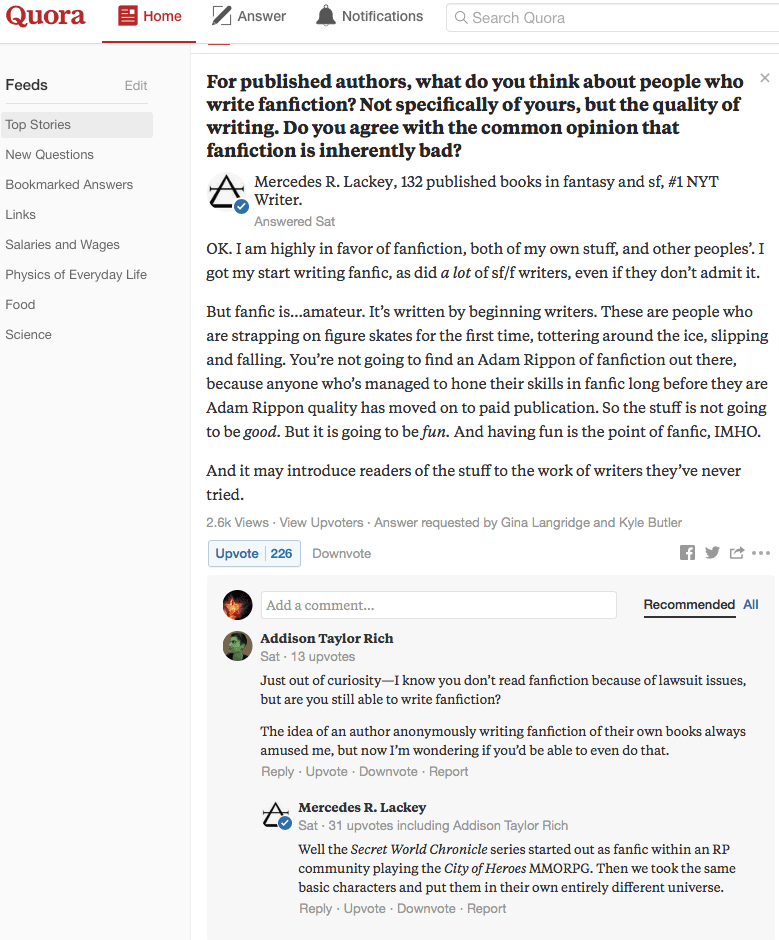
The basic sentiment is lovely (”Go, ye little writers!”), but the notion that no published writer is still writing fic is so clueless it’s laughable.
Fandom is full of published authors. And even if a writer hasn’t gone pro, don’t even try to tell me that means they can’t have Olympics-level writing skills.
A lot of fan fiction is so toe-curlingly good, it makes whole heaps of published works (especially of the “she boobily breasted down the stairs” variety) look like a preschooler’s first attempt at storytelling.
Fanfic can be amateur, yes. It can also be the best fucking thing you’ve ever read in your entire life, and if you haven’t noticed that, please don’t talk about it like you’ve any clue about the matter.
Wow, could she be more condescending?
‘I published a series that started as City of Heroes fanfic. Fanfic is never going to be good, because any good fanfic writers move on to publishable work. I see no contradiction in these two statements.’
OMG! WHAT THE FUCKING FUCK!!! I can make a list of excellent, outstanding, incredibly talented and creative fanfic writers a mile long, and I’m really only in two fandoms (OK, three, if you count “Sherlock”). I pretty much stopped reading published fiction, because – SO DISAPPOINTING. Could count published books I liked in the last two years on my fingers. One hand only. So here it is, the truth about published writers. BTW, I read A LOT since I’ve learned how at the age of 6, it’s not like I’ve read five books altogether and I did not like four. Oh, and one of the published books was so damn bad that I wanted to throw my e-reader across the room (Yuri Plisetsky moment). They made a movie, also damn bad. UGH. Seriously, there are writers of fanfic who are Adam Rippon NOW. Some are even Yuzuru Hanyu. So, there. .
OH MY GOD MERCEDES LACKEY GOES ON MY LIST
(I have a list of all writers who say annoying things like this about fanfiction. I don’t read any of the writers on that list.)
I’m pretty sure @copperbadge is the adam rippon of fanfic, if we’re gonna make that comparison. (although if we are making that comparison, I would actually go so far as to call him the yuzuru hanyu of fanfic.) his original stuff is fantastic, but his fic library is so much more extensive, to the point that I’m not sure it’s possible to be in fandom and not have read or at least been recommended something he’s written.I can think of two that went viral, even, just off the top of my head.
I wonder what her opinion of licensed novels is, since they’re, y’know, literally fanfic that somebody got paid to write. are they good? fun? neither? both? I mean, in my experience neither, but then it’s almost as if ideas like “good” and “fun” are subjective.
Aw, thank you! Yeah, I do find original fiction takes much longer and in some ways is less fulfilling; I love writing fanfic for fun. And most of my original fiction isn’t pro-published, though that’s a choice I made consciously.
To claim that only amateurs and beginners write fanfic is…..
Well, I don’t know much about Mercedes Lackey. I know who she is, of course, but I haven’t read her work. That said, I have a hard time being genuinely mad at her because honestly, people who only write commercial fiction don’t get into fandom spaces in any kind of authentic way very often. There are a few notable exceptions, but they tend to prove the rule. In some ways (at conventions, etc) content creators literally can’t engage in the way a fan could because they’re too visible, and in some ways (online discourse, fanfic) it’s difficult for them to do so because it can open them up to legal problems. And this is especially true of more senior writers in genre.
It’s likely she has encountered a small sliver of fanfic, if she’s actually encountered any at all in the last twenty years; if she hasn’t read any fanfic of her own work, then she’s probably only seen those deeply uncomfortable chat pieces where obnoxious television hosts make actors read bad fanfic about themselves. So I would guess that she is coming at the entire question from a position of, pretty much, ignorance.
I mean, when you come from a place of ignorance obviously you should keep your mouth shut, but we are conditioned to try and offer a complete answer when asked a question. And also sometimes we don’t know just how ignorant we are. “What do you think of fanfic” is honestly a bad question to ask someone who isn’t deeply engaged with fandom because they don’t have an accurate definition of “fanfic”.
All that said, I think it would have been possible to stop at “I like it; have fun, kids,” without “but they’re not good writers” which really heavily implies “but they’re not real writers.” I think that probably comes from a deep well of creative insecurity many writers have, that someone might be better at their stories than they are.






 Sandra Soapbox Cosplay