I’ve read a lot of scholarly
articles on Much Ado About Nothing that dismiss Don John as a terrible villain,
or criticise Shakespeare for the lack of finesse in constructing him, but
honestly, I’ve always felt like that’s the point.
Don John is no sly, silver-tongued
Iago – he is crude, brash and malicious. He makes statements like “I am a
plain-dealing villain,” goes about attended by idiot henchmen, and takes advice and inspiration for his plots from others around him.
But even so, this
weak caricature of a villain nearly brings ruin upon all of Messina.
How?
Because, even before he had made plans to trick Claudio into thinking Hero was unfaithful, the culture of Messina had already done most
of the work for him. Don John is not the true villain of this play; he is
merely an agent. The real villain of Much Ado About Nothing is the culture of
misogyny in Messina.
From the moment Benedick and the
soldiers return to Messina, they engage in lewd sexual banter and joke about
horns, adultery and cuckoldry. Leonato’s first instinct upon greeting them is to make such a joke, for when Don Pedro politely
inquires if Hero is his daughter the old gentleman immediately quips, “Her
mother hath many times told me so.” This banter speaks volumes about the underlying
misogyny and anxieties about female sexuality that the men share, and it works to
create an atmosphere that is ripe for Hero’s shocking rejection.
Thus, all Don John has to do is suggest
to Claudio that Hero is unfaithful, offer him a sliver of proof, and the prince
and Claudio, made susceptible by popular myths of female inconstancy, find the rest of
the proof themselves. Claudio starts to see certain cues as evidence of Hero’s
guilt where before they were badges of honour. He declares, “Her blush is
guiltiness, not modesty.” And so Hero, by the simple
machinations of a cardboard cutout villain, is publicly disgraced, left for
dead, and threatened with death by her own father, showcasing how quickly those
seemingly harmless jokes about women can escalate to actual violence.
What’s more, this culture of
misogyny is what keeps Benedick and Beatrice apart. These two
dorks start the play madly in love with each other, but their shared fear of
horns and cuckoldry divides them. Beatrice is also repelled by Benedick’s
attitude as a self-confessed “tyrant” to her sex, and patriarchal culture has
convinced her that no marriage could ever be happy, and no man faithful. Both
of them (but especially Benedick) must thus overcome and abandon patriarchal
values and the culture of misogyny they are entrenched in. Again, the culture
of Messina is the antagonist, not Don John.
Beatrice has the advantage of being resentful and rebellious towards patriarchal culture from the very beginning, and so it is Benedick’s
conquering of his sexist attitude that becomes the axis on which the rest of the play
turns. He starts off entrenched in a culture of toxic masculinity, but once
he acknowledges his love for Beatrice, and after he sees
Hero disgraced and left for dead, he becomes sickened by the views he
once held. Beatrice flies into a rage at her cousin’s treatment, and in no
uncertain terms rails against
misogyny and the patriarchy and the culture that nearly killed Hero. She wishes
she “were a man for his [Claudio’s] sake,” telling us that, were she a man,
she would use her position of privilege and power to protect women rather than
abuse them. Her next wish, “that I had any friend would be a man for my sake” is
a challenge to Benedick to do what she, as a woman, cannot: defend her cousin with
action, not words, and publicly oppose the culture of misogyny in Messina.
This makes her initial request, “Kill Claudio,” less a demand that Benedick murder his friend and more a plea that he
break with the toxic culture of male camaraderie. And Benedick agrees. In the midst of a play
saturated with jokes about women’s volubility and defined by the rejection of a
supposedly unfaithful woman, he then makes the monumental decision to trust Beatrice. He listens to her when
she grieves and finally asks her a single question: “Think you, in your soul
that Count Claudio hath wronged Hero?” When she replies in the affirmative, her
word is all the proof he needs to part with the prince and challenge his best
friend.
When he meets with Don Pedro and
Claudio, they are keen for him to validate their treatment of Hero with his
witticisms, plainly desiring to hear the japes about cuckoldry he had trotted
out at the start of the play. But with Hero almost “done to death by slanderous
tongues,” Benedick knows tongues are as deadly as swords in Messina, and so
leaves his wit in his scabbard. He challenges Claudio and informs the prince he
intends to discontinue his company, officially cutting his ties with their
little boys’ club.
Speaking to Margaret shortly after,
Benedick claims he has “a most manly wit… it will not hurt a woman.” He no
longer uses his tongue to scorn or denigrate women. Instead, he uses it to delight them,
turning his efforts to poetry and song, and courting Beatrice with the jokes
and witticisms he once reserved for his male friends. Shakespeare uses Beatrice
to convince Benedick, and by extension the audience, of the shortcomings of
masculine culture and shows us that true valour comes from men using their
strength to protect women rather than hurt them: for this alone may Benedick
call his wit “manly.”
Through their love, Benedick and Beatrice
conquer the true villain of the play: misogyny. Don John, who is merely the
agent, is instead undone by Dogberry and his idiot watchmen, who discover the plot and bring the truth to light. With all put
right, the end of the play provides the denouement where Benedick, having
proved his valour and cast off misogyny, is at last free to marry the woman he
adores. He makes a speech where he mocks the old views about women and marriage
he held, gaily advises the prince the marry, and tells Claudio “love my
cousin,” the implication being that the only way Claudio and Hero will live happy is
if Claudio follows Benedick’s example, throws off misogyny and loves and
trusts his new wife as Benedick does Beatrice.
Much Ado About Nothing, quite
simply, mocks the hypocrisy of patriarchal society at every turn. It questions
why men should demand chastity in women when they display none themselves, and
why women are thought of as sexually insatiable when experience generally
showed the opposite. The play’s accompanying song Sigh No More is even about the unfaithfulness of men. The lyrics
declare “Men were deceivers ever… to one thing constant never,” and the men of Much Ado tend to live up to this, being
generally lusty and faithless while the women are constant and faithful.
Shakespeare disproves common myths about female inconstancy by
making Hero the blameless victim of men’s obsession with female chastity, a
scapegoat onto whom all their repressed fears are projected. And Don John, the
active agent of the culture of misogyny, is a bastard, living proof of men’s infidelity and unfaithfulness.
So yes, Don John is a terrible
villain – but that’s precisely the point. His weak characterisation feeds neatly into the play’s subversive agenda. For what could this bitter, scheming man have accomplished had the culture of
misogyny not predisposed Don Pedro and Claudio to suspect unfaithfulness? What
power did he have over Benedick and Beatrice, and how did he serve as their antagonist?
Don John is not the true villain.
Misogyny is. Hero’s shocking rejection and near-death proves how dangerous misogyny
is, and how easily violent words lead to violent actions. Meanwhile, the
witty, sparkling lovers journey together to overcome their internalised prejudices, and provide vivid proof of what happiness a marriage based on trust and true equality can bring.
Much Ado
About Nothing is play about a battle of the sexes – and only once the two sides call a truce and
join forces to overcome the real villain, misogyny, may the happy ending be achieved.
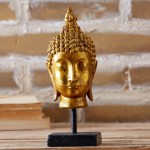
Yesterday, I went shopping at Homegoods with my mom for some interior decorations and a few gifts. And what do you know: Buddha’s heads, either in brass and sold as “antique” or dipped in bright neon paint. My mom shook her head in disapproval and laughed. This really got my mind thinking that shoppers have literally no clue what these statues’ heads are really about.
This really got my mind thinking about that Thai movie “Ong-Bak“ about how a group of thieves decapitated a Buddha statue’s head & how a Muay Thai skilled warrior volunteered to return it before it is sold in the black market. Cutting off that religious statue’s head is seen as an act of vandalism & violence. It is one of the utmost disrespectful marks one could do in the religion. The original heads were stolen from respected places of worship. Cutting off Buddha statues’ heads have been happening for who-knows-how-long originally by greedy thieves.
And now they are replicated into fashion statements or interior decorating. They really have such a dark history behind them that nearly a lot of people had forgotten. (None of those pictures belong to me.)
The Buddha bust, usually in a faux Thai or Indonesian style, is one of the ugliest and most ignorant bourgeois accoutrements one can posses. Not only is it a bland and obvious attempt to purchase the appearance of spiritual depth, its presence immediately belies a total ignorance of the context and history of Buddhist images themselves! A severed Buddha head, plundered from Borobudur, in the corner of a gentleman’s study is a romantic relic from a bygone age when the world considered genocide and forced military conquest a viable means of affairs. To keep a stolen cultural artifact as a trophy is to deny a sovereign people access to their own cultural heritage to satisfy one’s own ego. That the idea of the severed Buddha head as decoration flourishes today is a disappointing remainder that the aesthetics marketed towards the middle class are a cheaper version of those objects collected by the wealthy, further divorced from their original context.
The Buddha is not an accessory or a complement for your decor.
Reblogging for historical context I didn’t know about.
This is good to know.
My Buddhist relatives display full statues of the Buddha; seems to me that this ridiculous Buddha head thing would be sacrilegious AF. That this is considered fashionable is disgusting. Like, how would Christians feel if they saw Jesus’ head display?
But y’know, us Catholics, we display his mangled corpse on the crucifix so maybe I can’t say much.
I don’t display religious iconography that I am not a believer of. (It sort of confuses me how/why people would display a piece of religious iconography that they do not believe in, in the first place.) Religion/culture isn’t there for (let’s face it, mostly colonizer’s) decoration.
I once saw this chinese inspired interior design book which loved using stuff like this. Similarly disrespectful was how they recommended using a 1.3m tall long and thin table in the living room.
It takes one look for most chinese people to tell you that the table was actually an ancestral prayer table. Older chinese families use it to hold deceased family members names and pictures for prayer ceremonies.
Using it like a living room tea table is kinda like hanging clothes on a cross because you think the long arms are great for clothes hangers. At best it looks baffling weird to most Chinese people. At worst it is VERY disrespectful.


















 Sandra Soapbox Cosplay